Fresh walls beside tired trim look unfinished, and most houses in Gwinnett County are carrying tired trim: baseboards nicked by twenty years of vacuums and strollers, door casings gone yellow, and a six-panel door on every bedroom, closet, and bath that has never had a second coat. Trim is slow work done close to the floor, which is why it is the part of a repaint that gets rushed most often, and why a trim-only job is worth booking by itself in a Grayson two-story or a Lilburn ranch whose walls are still in good shape.
Oil or latex underneath
The first question on any trim job is what is already on it. Houses finished through the 1990s often have oil-based enamel on the woodwork, and latex brushed straight over oil lets go in sheets within a season. A cotton ball with a little rubbing alcohol answers the question in a minute: latex softens and comes off on the cotton, oil does not. Over oil, the sequence is a cleaning, a scuff-sand, and a bonding primer before any finish coat; over sound latex, a cleaning and a light sanding are enough.
Baseboards, casings, crown, and chair rail
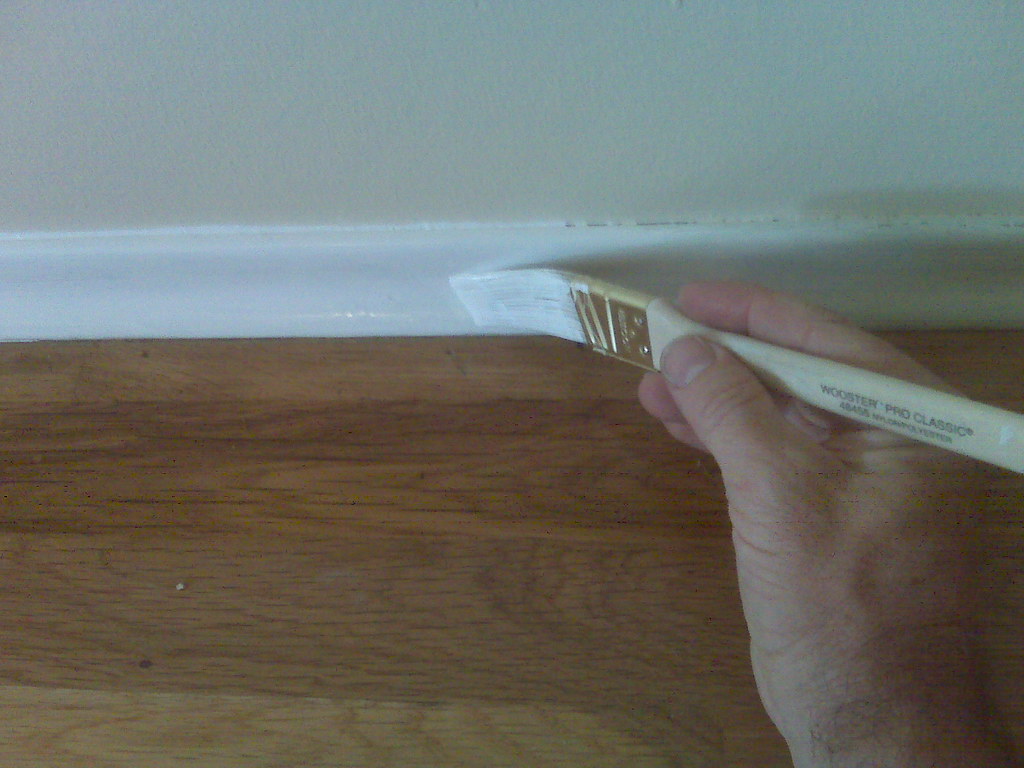
Baseboards take the most abuse and need the most prep: dents and gouges filled and sanded, the gap along the top caulked so board and wall read as one line, and the joint at a hardwood or tile floor left uncaulked so the floor can move. Casings around doors and windows are cut in against the wall by hand. Crown and chair rail, common in the dining rooms of the 1990s houses around Dacula and Snellville, are brushed from a ladder or a plank with the line at the ceiling kept straight. On a two-story house a full trim package can take more brush hours than all of its walls, and an honest quote is priced that way. Stair railings and balusters are a separate project, covered on the stair railing and banister page.
Six-panel doors, slab doors, and French doors
Most Gwinnett subdivision houses came with molded six-panel doors, and they are tedious to paint well: each panel's raised profile wants a brush, the flat rails and stiles want paint laid off in the direction of the grain, and the edges need coverage without drips onto the hinges. A door can come off, lie flat, and be sprayed for a factory-smooth finish, or be painted in place with its hardware removed and a self-leveling enamel that flows out its own brush marks. French doors and glass-panel doors add muntins and glass to cut around and are priced by the door. Either way the door stands open until the enamel sets, so it does not stick to the stop.
Enamel, sheen, and color
Trim and doors get a harder paint than walls: an acrylic or waterborne alkyd enamel in satin or semi-gloss that wipes clean and resists the knocks walls never see. Bright white is still the most requested trim color across the county, but dark interior doors, black in particular, now turn up in many Suwanee and Hamilton Mill repaints, and a dark door shows every brush stroke, so it is either sprayed or brushed with real patience.
Older trim and the lead rule
In a home built before 1978, the woodwork is the likeliest place for old lead paint, and scraping or sanding it beyond a small area is work Georgia's lead renovation rules reserve for a state-certified renovation firm. Sound trim can still be cleaned and recoated without disturbing the old layers, and the walk-through starts with the build year so the quote covers work that can lawfully be done. Trim that is split, rotted, or missing is carpentry and is named as such; nail holes and dents are part of the paint job.